Ever since Sage Parasurama with a flick of his able wrist propelled his divine battle axe from Gokarnam to Kanyakumari and magically reclaimed the strip of land called Kerala from the sea, it has been a balmy, temperate place. The Keralites, spoiled beyond measure by the idyllic climate, the natural beauty and the sedate pace of life in the Sage's own land, (now dubbed God's Own Country by the wiz kids of Stark Advertising who "sell the State" for Kerala Tourism) were the only people who stridently complained about the HOT summers and the BLUSTERY rainy season. If they had travelled around and discovered for themselves what heat meant, or for that matter cold, they wouldn't have dared to open their mouths again.
We had our share of the heat spells, and admittedly, a fair share of the windy monsoons. But more or less pleasant and balmy weather was the hallmark of the land all along, not only when the tough Sage had directly supervised the running of his pet country, but through the later centuries too when a string of kings and chieftains held sway over the land. Had it been otherwise, it would have found sure mention in that delectable "garland of legends" ('Aithihyamala') by Kottarathil Sankunni, raconteur par excellence. The Brits, for all their colonial faults, couldnt be said to have been lax when it came to documenting the climate and weather patterns of the sub-continent. Also, the Maharajah of Travancore, who took the initiative to establish an observatory, one of the oldest in the sub-continent, was an amateur weatherman himself. The long and short of it is that never was recorded in the history of this ribbon of land any typhoons or squalls or suchlike manifestations of the anger of the weather gods.
Until the fateful day of July 8, 1988.
According to the experts of the Indian Railways (whose main business we thought was running trains efficiently and on time--at least trying to-- and not weather-watching), Nemesis in the guise of a tornado stealthily and suddenly appeared and lifted ten coaches of the Bangalore-Kanyakumari express train off the Perumon bridge and plunged them into the depths of the Ashtamudi lake, killing about 105 people. That many in country boats were fishing nearby did not deter the tornado as it was confident it could do its dark deed with absolute stealth. Not a single palm frond nearby was shaken by the tornado --such was its stealth and focus! The eyes of the weather men and their weather radars were clouded over with stealth technology by the tornado while it struck, so that all over the country no unusual weather was observed or recorded.
It was usual right from the days of the British Raj for officials to devote considerable time to personal hobby interests, and more so when their jobs involved long periods of offficial inactivity. The railway Safety Commissioner's job was one such. In times of no breach of safety, he spent time idly like a chafing war horse. It was quite probable that he had in his spare time over the years cultivated an intimacy with the vagaries of Indian weather that had probably escaped the eyes of the harried regular weathermen. He knew the stealthy tornadoes intimately.
One look at the "mysterious" (the 'mystery' had to do with "how did it happen?" But to the layman without much imagination, it appeared that some flaw, probably in the rails, had caused the train to derail and plunge into the lake) accident site convinced the Safety Commissioner that the villain was a stealthy tornado! After due investigations and examinations of witnesses, most whom as typical Keralites were ignorant of what a tornado was, he submitted a detailed report. Suffice to say the report went to great lengths to ensure the safety of the railways and its minions in the post-tragedy scenario. As a wag pointed out at the time, the people were fools to think that he would act like the Public Safety Commissioner; his official designation amply clarified his duties, and he only did what he was supposed to do.
Whether the accident and the tragedy was the result of human error or oversight, his choice of an "Act of God" as the causal force had about it a stroke of genius and benevolence. In these days of Ahimsa, no scapegoats were needed to satisfy the bloodlust of the public. Probably what guided him was also the philosophical resignation that whatever you did could not bring back those who had found a watery grave on that tragic day; surely the plight of the living was supreme, whose lives could be made sheer hell by unpleasant and unnecessary questions that could be raised by all and sundry. The tornado upon whom the blame was fixed for the tragedy was sure not to protest the finding of the Commission, as it was unlikely that it would visit Kerala again for another Millennium or more. This is how public servants and Commissions of Inquiry should function. Find a generally acceptable and credible culprit and close the files after due legal process. Thanks largely to such practices, the railways could get back to their business of keeping the largest network of rolling stock in the world rolling steadily and smoothly.
Along with the Indian Posts & Telegraphs (now a doddering non-entity, thanks to Liberalization era reforms) the Indian Railways shared the distinction of being behemoths who were a law unto themselves. The disdain exhibited especially by the telephones department when a poor customer sought to raise a complaint of over-billing is only legion. They claimed, like the government of today does with the list of names of the black money kings, that they had immunity and they were not under obligation to make public "technical information" like the phone usage details of an individual. Finally that saviour of the "Aam aadmi", the Supreme Temple of Justice, ruled that so long as the department took money from the public in lieu of a service, it would be bound by the relevant rules. And the behemoth had to, unwillingly though, shelve its hauteur and behave.
The Indian Railways often is something like an empire with its own laws, and answerable to none. When sometime back a couple of lady academics whom I knew well undertook a journey from Trivandrum, Kerala, to Hyderabad, the most precious content of their baggage was their doctoral theses and related papers. Their "possessive behaviour" triggered the antennae of some among the legion of thugs and thieves ( I am not here meaning those in the employ of the railways and who practice the above trade), cut-purses and bag snatchers who, with impunity, make an excellent living off the many trains plying the length and breadth of this vast land of ours. That night their baggage was stolen. Luckily the ladies awoke in time to discover their loss and tried their best to get the Ticket Examiner do something about it. He, true to his official training and behaviour, brushed aside their plaints and pleadings and went off in a huff. Thanks to the initiative of co-passengers, the broken-open suitcases were discovered in the vestibule--where the chagrined thieves had dumped them. The papers were in disarray and thrown to the floor and the wind was doing its best to distribute it over the countryside. The duo, downcast and dispirited, got down at the next station and lodged a complaint with the Station Master and the police, who apparently believed that sympathetic behaviour did not go well with officialdom. With much hardship they attended their interviews and returned.
Months later the machinery of justice, turning ponderously, finally issued a summons to the professors to attend a hearing in some north Indian city court. As they were busy academics and as they had good legal advice, they were finally able to prevail upon the railways to shift the venue to within Kerala. At the hearing the tone adopted by the counsel for the railways made it appear that the two ladies had started from Kerala with a load of worthless papers with the express aim of defrauding the railways of a tidy sum of money! Fortunately this vein of questioning and argument did not 'gel' with the presiding Judge and, pulling up the railway's counsel for his frivolity and lack of civility, reminded him about the railways contractual obligations etc (buying a ticket entitles you to such, no less). In the end damages were awarded to the two lady academics, and all agreed that it was not the money but the spirit of the award that made the whole exercise worthwhile.
A young man who lost a couple of his fingers when a damaged window shutter fell on his hand was chastised by the railway counsel for not exercising caution and common sense and for trying to make an easy living by embezzling money from the railways. If you know the phrase "adding insult to injury", you will know exactly how the plaintiff felt. Fortunately some eagle-eyed youngsters discovered that the same coach was continuing in service without any repairs, and reconsideration of the case laid the blame squarely upon the railways, leading to a redressal of the original complaint.
Instances like the above are countless and they read like an enumeration of the railways' continuing criminal apathy towards the plight of passengers. They take your money and act as if they are doing you a favour. They act as if they are an unquestionable law unto themselves, and time and again they prove in the lawcourts and in public that they cannot be "touched".
It is perhaps some sort of a tragic coincidence that on the 23rd anniversary of the Perumon tragedy, a 23 year old young girl's life was snuffed out, largely as a result of the continuing indifference of the Indian Railways. Soumya, an ill-fated commuter in the Shoranur Passenger train, was the victim of attempted robbery and later cruel rape and cold-blooded murder by the miscreant who had pushed her out of the running train. The tragedy shook the conscience of Kerala in many subtle ways. But televised reports of the railway Divisional Manager's conference the next day presented "text book attempts" at discovering novel ways of shifting the blame. It was patently clear that the railways were culpable for the lack of any security arrangements for the passengers despite long-standing and vocal demands by the travelling public. Technicalities will always be found to explain away inconvenient truths and to brush the dirt under the carpet. Such is the inhumanity of officialdom, especially in post-independence India.
The railways have grown into a huge machinery of indifference and its minions are apparently strangers to what is commonly called conscience. Its responses are, to put it another way, typical corporate behaviour. Wash your hands of all inconvenient truths and distance yourself from all that could be troublesome to you. Money-minded corporates could get away with such behaviour. But in a national service like the railways, funded by public money and meant as a service to the tax-paying public, and NOT as a profit-making mechanism, this sort of anti-people behaviour can no longer be tolerated. The concept of the Welfare State might be anathema to liberal economic pundits like Mr Singh or his cohorts, but India has a set of Constitutional guiding principles that are distinctly different from the personal preferences of people who come and go, or people who somehow get in and refuse to go.
Ours is an elected democracy and public instititutions must fulfil their public obligations, and accountability is not something that can be shifted to "the other man". This should be insisted upon with the clout of the laws of the land. We recall with gratitude how the Supreme Court once made the telephones Goliath bow to the little David, the "aam aadmi". Once again the powerful gavel of the Justices should hammer into indifferent giants like the railways the need to displace their arrogance and impunity with social commitment, civic sense and a pro-active approach. Officials should realize that they are nothing if not the servants of the millions whom they serve every day. This is the right time for the railways to augur in some changes. They have a sensitive woman heading the ministry, and perhaps a woman's touch could prove to be the magic element to restore what was lacking till now.
It is so sad that on the 23rd anniversary of the Perumon tragedy when a child born back then was sacrificed again for no crime of hers upon the altar of the indifference of the railways. Govinda Samy's hands are literally stained with the blood of Soumya. We witnessed the railways, like Pontius Pilate after the sentencing of Jesus, ritually washing their hands of all liability and culpability. But anybody could see that the water has turned a deep crimson red...with the blood of the innocent young girl.
QUO VADIS, railways???
* * * * * * * * * * * *

Thursday, February 24, 2011


Wednesday, February 23, 2011
THE GREAT INDIAN HOPE TRICK
Legend has it that it is the greatest of the Indian conjuring tricks. And till now none has been able to decipher fully the secret of the great magic trick.
The Great Indian Rope Trick is the ultimate illusion, the conjuror's magnum opus.
In the simpler version, the magician, playing on his pipe like a snakecharmer does, 'charms' a stout rope to rise into the air , and when it is high in the air, a little boy climbs it. In other fancier versions the rope is thrown into the air and then it is persuaded to rise and rise until it disappears into the clouds. The little boy climbing the rope soon vanishes from sight. Soon the magician would climb after him with a sword and he too vanishes. Then dismembered organs start raining upon the ground. Moments later the magician reappears and with an "abracadabra" or equally powerful incantations, "re-assembles" the little boy. And all ends well. Applause. Clink of money.
Within the last hundred years or so only a couple of people have managed staging the simpler version of the rope trick before audiences. But hurry not dear, gentle reader if you were on the verge of mourning the passing of our position as masters of illusions. The stage is now set for perhaps the greatest magic 'trick' of the century. And like every good conjuring trick, this too is more 'trick' than treat.
It is The Great Indian Hope Trick.
To the Indian languishing in the doldrums of helplessness and hopelessness in the "Kali kaal" of mega-scams, serious diversions like the GIHT offer a much-needed relief, and perhaps a safety valve for their pent up tensions. After the great Parliamentary Kururkshetra battles, the hard-won 'JPC victory' is indeed heady wine that fills one with equally heady hope.
Enter the illusionist, doing his best to look dapper in the customary blue turban, mumbling mumbo-jumbo, and throws the 2G JPC hope/rope into the air. The people are charged with hope. Yes, this is going to be the real thing, and they jostle for ringside seats. This JPC stuff will go all the way into the rarefied regions of corruption and reveal everything. Surely magicians, we forget easily, are adroit entertainers with their fingers on the pulse of the audience. The "abracadabra" and the mumbo-jumbo and other loud incantations fill the air, all the while many climb up and down, appear and disappear. Then the fun part will begin with swords being brandished left and right, and body parts raining down and making the whole scene bloodier than an abattoir on Christmas eve or the guillottine platform at the peak of the French Revolution. The audience, brought up in the grand traditions of Bollywood and the Indian television, loves all that gore and the loudmouthed dialogue, and go ga-ga over the whole tamasha. After the requisite number of 'scenes' to classify it as "serious entertainment", the show will come to a close and the magician will put everything/everyone back together again, to great applause. All would have forgotten what the whole tamasha was about and go their respective ways --happily entertained. None knows this better than the conjuror and his cronies.
I dont think one needs to be an astrologer of repute with a laser vision to pierce the darkness of the murky future and make such a prediction. It is the natural outcome of any conjuring trick. All ends well and the magician goes home pocketing your money. How does every magic trick work? There is nothing great about it. While your attention is focussed on the trivial and you are hoping for something 'miraculous' to happen, the magician is pulling his strings behind the scarf, and with sleight of hand, deceiving you. Illusion? Deceit? Yes Sir!
Simply put, it is grand deceit! And very convincingly and entertainingly done too! The Great Indian Hope Trick is not going to be any different ... hand on heart!
If you are keen, you can dig a bit deeper into the history of all the earlier JPC 'hope tricks'. How many were there? I would rather emulate our PM and say, I dont know because I was not told. Bliss!! (Gautama Buddha was in all probability not familiar with the bliss of ignorance; else he wouldn't have searched long for the ultimate bliss.) How many JPCs were boycotted "for political reasons"? As if politicians need any a-political reasons! Every reason they come up with is political! What were the findings of the various JPCs constituted since the first R-day? Has a single politician been punished or at least inconvenienced upon the findings of any JPC? Forget about the culprits being decapitated or their limbs cut into pieces--though that would have been their fate if our Founding Fathers had the wisdom to borrow the strict Sharia laws instead of implementing a tame civil code in our country! Ask away any more JPC questions that come into your mind. The answer, I can assure you in every case, would be that nothing 'untoward' happened and that it ALL ended well.
What more do you need? You had your JPC, your high hopes, and you were entertained grandly at your own expense for quite a while, when you had been in a state of "willing suspension of disbelief". Now you can all go home; the trick is over. The conjuror is confident of the outcome. Otherwise how could he still harp on the fact that he is putting on the show as a result of the strong persuasion/coersion of the opposition, and not because he feels there is a real need for one! What more indication do we need for concluding that this is going to be another stage-managed show? If the recent well-rehearsed "media interaction" is any pointer, surely the man with the bag of tricks knows how to pull off the "hope trick" too!
So the conjuror is all set and he is playing the pipe and coaxing the rope, and along with it the hopes of the public, his audience, into the blue yonder. As we stand transfixed at the sleight of hand that would bring us entertainment of a rare nature (for which we have already paid in advance with hefty taxes), remember to administer a strategic pinch to one's own person once in a while and maybe one to your immediate neighbour too, if only to prove to yourself that you are awake and not under any spell.
Remember how fond we are all of magic tricks. Forgotten those days in school when the street magician put in an appearance? The child in us still loves those tricks. But let us also not forget that this is not the time for frivolous entertainment. Hope is a serious state of mind and it is perhaps the only thing that propels you along through a life of vexations. And guess what, hope is ALWAYS positive. Tricks have no place where hope reigns.
And be sure to the tell the conjuror that if he knows the rope trick, to get on with it--fast. And make no mistake about it, the one trick we would ALL love to see would be the one where the guy "charms" the heavy rope into a magical noose that would fly to the necks of the guilty.
No less --if he is serious about the applause at the end, and his 'salarium'.
* * * * * * * * * * * *
Sunday, February 20, 2011
THE NEO JOURNALISM SCAM
Another 'great' scam broke the surface right beneath our noses last week. But most of us missed the 'tip of the scamberg' for various reasons.
This is the great Neo-journalism Scam. No newspaper has yet come out with investigative disclosures about it, nor have the omnipresent/omniscient channels aired any secret footage, though the whole thing had happened “right in their backyard”, so to speak.
Journalism was, in the good old days, confined to print and the average Indian still could recall names like The Times of India, Hindustan Times, Indian Express, The Hindu and a few more, not to forget those stout fourth pillars built in the vernacular. Those with long memories and a fondness for the heyday of journalism in India would surely recall the names of many stalwarts, adoration for whose iconic status made many a young man take up journalism as a career, and either make good (a rare event) or, mostly, sink in a sea of drink. Today perhaps the only survivors from the army of old warhorses are people like Kuldip Nayar, S Gurumurthy and T V R Shenoy, the grand old men of upright journalism.
Journalism was mostly reportage, and reportage was largely about bringing before the common man things that he ought to care about and which affected his life and existence, and which he could easily understand once a capable journalist who 'knew his marbles' had spent some time analyzing the issue. Once in a while, once in "an exciting while", journalism was about digging muck, and bringing up murky issues and goings on and shining the light of disclosure upon them. This the general public enjoyed with glee, though mostly they were the victims of these scams the journalists dug up. Politicians and corporates might borrow the phrase "who is afraid of (V) Woolf" to indicate their disdain for the pen-pushers, but they took care to wine and dine them and to be on the "right side" of these powerful scribes, largely from a fear of their ability to upset the apple cart with one flick of their pens, and secretly from the conviction that it was not easy to influence the true journalist beyond a point.
This comfortable state of affairs was upset with the arrival of private TV channels in the middle of the last century. With the proliferation of the 'visual media', a bevy of high-voltage, 'eye-candy' types replaced those who had studied the ropes of journalism. And who owned the channels? With the more than a crore of rupees a day hire for the satellite transponders and the other astronomical costs for equipment and studios, not to speak of the salaries of skilled technical and other staff, it was an expensive ball game. Result? Only the very well heeled could dabble with this new medium, the darling of the masses. And corporate money, black and white, found its way into the ‘channels’ and as everyone knows, (or should know) corporate cheques comes with a lot of attached strings, visible and otherwise.
It is ironic to note the upsetting of journalistic values with the coming of visual entertainment. What once got the reader's respect was the journalist's perspicacity, his/her perseverance, and his upright reportage. With even the day’s news putting on the garb of high entertainment on television, the poor journalist who slogged in the background was forgotten and the limelight was upon the 'anchor' or the newsreader--whose journalistic acumen was virtually zero, but whose 'eye-candy' factor was near 100 per cent.
I am not for an instant forgetting stalwarts like Tim Sebastian of the BBC, who made watching an interview a uniquely cathartic experience. Nor am I insinuating that the Indian subcontinent and its television had spawned only duds. But that is all in the past...and passe. I am basing my take on the current crop of the “cream of Indian television journalism”. I had thought that people like Vir Sanghvi, Rajdeep Sardesai, Barkha Dutt et al were charged with the active blood of young go-getters who would stop at nothing when it came to bringing good TV journalism to the masses. But no more after their recent self-indictment -- in full view of the entire nation.
INDIAN TV JOURNALISM IS DEAD. What appears to wear its clothes and lip-syncs to an 'approved' script is the ghost of an accepted Indian practice--Paid Journalism. This then is the Neo-journalism Scam. Are there any more journalists of the old school left in India who could take up the Herculean task of digging up the truth behind this unsavoury transformation? No, the question is not WHETHER they were paid or not. They were, to judge from their 'convenient' silence and the adroitness with which they avoided all kinds of questions that would have occurred to a rookie journalist on a petty two-penny assignment. What would tax the investigative journalist's brains is --WHO paid the money and HOW MUCH was paid in order to buy their silence and their complicity.
I am, of course, referring to last week's nationally televised TAMASHA OF THE YEAR--the PM's "coming out party" on television before the cream of the media.
Interviews are about asking the right questions, beginning with the most innocuous perhaps, drawing the interviewee out with more related questions and then popping the quarter-million, the half-million and then the million-rupee questions that leave little squirming space for the person on the hot seat. Those who have watched Mr Tim Sebastian’s interviews would instantly know what I mean. But one thing has to be admitted--to the honest man who has nothing to hide, no interviewer can conjure up an instant nightmare, try as he might. It is sheer nonsense to believe that a 'clever' interviewer can 'trap' anybody. No, and NO. ONLY IF you are fond of dark corners to hide, then that is a possibility, where you will feel trapped by the spotlight of intelligent questioning.
If you watch a recording of the whole apparently well-rehearsed 'tamasha' with 'Singh as King', you would discover that not even a single worthwhile question was put to the PM. Nobody in this country is naive enough to believe that spirited youngsters like Mr Sardesai and others of his ilk have forgotten all that they had learned in the schools of journalism. Their apparent amnesia is the surest sign of their having taken "favours" to limit the interview to nothing but an exchange of sweet nothings.
Like the clarion cry of "physician, heal thyself", it is time for another loud exhortation to reverberate in the Indian media firmament now-- "Journalists, investigate thyself". Are we to believe that the whole thing was "spontaneous"? C'mon... How many meetings were there between the "powers that be" and at least some of the journalists (and their corporate cronies and bosses) which laid the foundations for the “interview”?? Back in the good old days when sages like Vinoba Bhave observed a vow of silence, people would throng to the prayer meetings at which he would finally break the silence to listen to his words of wisdom. Mr Singh after his long vow of silence, given to whom we dont know, needed to 'break his silence'. And the entire nation rallied before the TV sets to witness the great man wilt before the machine gun fire of questions and spill the beans. But like every well-compered program, this too went to the complete satisfaction of the “backroom boys”. (A word of apology is in order—the gender distinction is out of place after Ms Radia and her adroit PR capers!)
The million rupee question...oops! the lakh-crore rupee question is, WHO PLANNED THE MEDIA DRAMA? What was the "quid" promised for the quid pro quo? Will we ever get answers to that and other related questions?
SHAME on you, the greats of Indian television, for not exhibiting the common sense of even a semi-literate man in the street, let alone that of an average journalist.
SHAME on you for lacking the courage to at least politely call a spade a spade.
SHAME on you for not knowing the difference between 'dharma' and 'adharma'.
SHAME on you for not doing your minimum to speak in defence of the poor millions of this nation at whom a pittance is thrown as subsidies.
SHAME on you for having willingly sold your integrity and HUMANITY, God knows for how many pieces of silver.
What shall serve to wash away from Indian journalism this limitless stigma? No “Ganga jal” for you, not so gentle men; your touch shall pollute the divine river beyond redemption. Perhaps the only choice before you now is "sati" --a jump into the purifying flames of the pyre of journalism that you chose to light on that day, unashamedly and with false unction.
* * * * * * * * * * * *
Tuesday, January 25, 2011
CRIME AND PUNISHMENT
Of Being Zero-savvy
It is too sad. Most Indians have forgotten most aspects of their cultural roots, roots that gave them credit for many things and gave them some respectability as carriers of a great tradition. Thanks to the Indian Space Research Organization and its perspicacious pilots at the helm, today Aryabhata is a name that is well preserved in the minds of at least the school children and votaries of quiz programmes. This genius, who lived in the 478--550 AD in the court of the Gupta emperors, was mathematician-astronomer non-pareil. That he was probably born in Kerala is an idea that opens up other possibilities, surely. It is the words of Bhaskara I, who about 100 years later wrote a commentary on his masterly treatise 'Aryabhatiya' that sums up his achievements:
"...Aryabhatta is the master who, after reaching the furthest shores and plumbing the in-most depths of the sea of ultimate knowledge of mathematics, kinematics and spherics, handed over the three sciences to the learned world."
And as the world knows and accepts, Aryabhata was the one who invented the grand concept of the zero and unleashed it on the world.
The power of zero has never been more apparent to the non-savvy guy on the street than now. Aryabhata himself had stated that his work 'Aryabhatiya' was composed 3,600 years into the Kali Yuga, when he was 23 years old --which corresponds to 499 AD. That tells us we are into Kali Yuga by about 5,000 years plus. Not bad when you notice that at least one good has come to pass. The average person, whether in India or elsewhere, I am sure has his/her difficulties when it comes to tackling numbers with more than, say, half a dozen zeroes. Perhaps in a fitting revenge of the past, in India 5,000 years into Kali Yuga, we are now faced with the mammoth task of digesting numbers with God alone knows how many zeros. Surely we are going to need all the blessings of these past masters if we are to make head or tail of all those zeros. Aryabhata, Bhaskara, Varahamihira and the great minds of the past are having the last laugh as we grapple with the 'genie from the bottle'.
Of Black and White
The airwaves are saturated with zeroes. The print media, for once, is foolishly ignoring their advantage and playing a low-key game. Whether it is a few lakh-crores or maybe a few crore-lakhs, it just doesnt make all that difference when you listen to it on the TV channels. On the other hand, just imagine the impact in print of 1 followed by, ahem, a whole procession of zeroes. Who bothers if you can count? But the sheer impact tells you that it is HUGE. English is a poor language and has no adequate word to describe such a size. Perhaps India should, along with 'curry' and 'verandah' and 'pucca', contribute an apt word too to describe figures of such grand proportions.
Be that as it may, let us take a closer look at all these zeroes and what goes with them. It is the latest revelations about the wealth stashed away in Swiss and other banks. These days when even diehard Socialists are shouting themselves hoarse about the need for wealth creation, what is wrong salting away some wealth in a bank or two. The trouble is, they say this is all "black". Ah, the colour of money! The government in its wisdom does some exercises every March-April ("...beware the Ides of March..." Google that and be scared!) and announces a financial 'road map' for the country and its citizens to follow. This involves sums with Aryabhatiya scales of zeroes, and in the end they append what is termed 'deficit'. The common man doesnt understand much about that, except that the government is spending more money than it has. Good, we think, for them; but we pay for it all with runaway inflation and price rises and all that. In brief, the government approved financial 'tamasha' is supposed to be all in "white", despite the existence of the deficit. Anything that goes beyond that and is not accounted for is all grouped under "black".
What the average Indian thinks of black money is that it is the paltry sums made by the average trader and businessman by defrauding the government of some taxes. If the average tax is say, ten percent on goods etc, it will take a long time and millions of tranasctions before a trader could amass black money totalling lakh-crores. But what shook the man in the street has been the pronouncements of the Honourable Judges of the highest Temple of Justice of this land, perhaps the last sanctuary of the common man in this country. They speak in strong terms of the plunder of the nation to the tune of lakh-crores by the 'kings of black'.It sure paints a totally different picture. And the average citizen naturally has a tendency to go by what the Justices say than by the words of Kapils and Sibils, blue eyed boys though they might be. Here is money that has been plundered from the law-abiding, tax-paying citizens of this country and has been salted away in safe havens outside our country. And the money amounts to...forget it, you wont be able to make sense out of the zeroes; just take it that it is many times more than what the government earmarks for our national budget. Oh my God!!!
Of Treaties and Testosterone
Even if you are the type who believes only half of what you hear, definitely this is going to make you think. Suppose we get all that money back into the country, you are not going to need any loans from the World Bank or the ADB, who are all basically Shylocks in expensive suits after their pound of flesh. If we are to believe that what has come out now is only the "tip of the iceberg", then every single Indian is going to end up with a tidy sum in his name in a government-sponsored bank account. No, not in Switzerland or in Germany or in that unpronounceable place called Lichten--what, but in our own Nationalized banks that had weathered the recent economic tsunamis with aplomb.
C'mon, quick march, let us get those baddies and get all that money that is rightly ours. Not so fast! Says who? Says our own beloved PM, the FM and others who are "in the know of things". What, may one ask, is the problem? It is the treaties, my dear sir. Treaties, the dictionary tells us, are agreements between two States or Sovereigns relating to mutually agreed and mutually beneficial things/situations etc. So if we have a treaty with say, Mauritius, for trade, what we will expect is that we will agree to imports and exports between the two countries that will be to the benefit of both. If the treaty is about the extradition of criminals and such like undesirables, again the conditionality of mutual benefit is there. Only a nincompoop would think of inking an accord that would benefit only the other side.
And talking of treaties and Mauritius, one is reminded of the treaty that India signed with that nation sometime back. The then FM was at the time waxing eloquent about the gains that India would reap as a result. But after all these years of runaway inflation and what not, the average Indian is yet to be persuaded to see some of its advantages, except, if we are to believe the naysayers, that it has served as a conduit for ill-gotten 'black monies'. Whatever is the stuff of treaties and diplomat-speak, one thing is certain. Treaties, national or international, should never overstep the dictates of our legal system and the laws of the land, which are supreme. One cannot have two different laws applicable. The 'umbrella' should be our laws. Period. If some idiot in some ministry has put his signature on a piece of paper without paying due respect to the established laws of the land so as to circumvent its intent and effectiveness, it is time he was sent to his "father-in-law's house" posthaste. Dont we have a Law Minister? A Foreign Minister? And a Prime Minister, who are all paid handsomely to look after all these affairs?
In India, to do the business of govenment as per the dictates of Indian laws, all one needs is a conviction of your just stand and some testosterone in your system. It is a documented fact that testosterone levels decline with advance in years. Still, one doesn't suspect that the collective testosterone levels of India have fallen to such abysmal lows as has been apparent now.
Of Crime and Punishment
Recorded history is full of attempts at reconciling crime and its punishments. Googling for such terms would bring in results that would curdle your blood with the gruesome nature of some of those punishments. Ah, but we who live in "civil" societies need not quake in our boots or chappels. Already the FM and the government is thinking of some 'amnesty' for the 'blackies' if they promise to declare their cache and bring back some as 'legit white' into the country. What a lark! Make a cool 1,000 crore as 'black', park it abroad and get some good interest too for a while, get in touch with the Financial Ministry honchos and tell them, "Look here I wish to help the country, what is going to be your percentage?" You strike a deal and none could be wiser, all for the price of a "Legit-white" stamp from the Ministry! Hooray!!
On second thought, I was struck by some of the things that had escaped me in my hurry to digest all those zeroes. We are still a Republic--arent we reminded of that on this Republic Day! I will leave it to your memory of those civics lessons in school to spell out what a sovereign republic means. We have our laws and we have at least one of those Four Pillars of our democracy standing erect with not much damage. The Romans were perhaps the first who codified laws and naturally, they included various crimes and punishements too. The punishment meted out in those days for what could be termed broadly financial misdemeanour was attachment of the property and exile of the accused. We are on safe ground there. We are in the Indian soil and ruled by our own laws and the legal system, and safely out of reach of any 'treaties' or such bogeys. And the 'accused' are all holders of Indian citizenship and they have vast holdings in India. So what is preventing the ponderous machinery of the government from going to work on extracting what is due from these clever sultans of 'black'?
I dont think we have to ask the FM or even the PM or any other dignitary to do this "dirty work"; it is infra dig. We have minions enough in the Income Tax and other ministries who are 'at home' doing such work a per the laws of the land. Just give them the names, if you wish, in a sealed cover, and before you could say 'Jack Robinson' (or, if you are a patriotic Indian, before you could say 'Kapil Sibal'!), you would hear the sweet sound of money tinkling into the nation's coffers.
Yes, why are we not doing that ASAP?
That is the 'lakh-crore rupee' question in the mind of every upright Indian on this R-Day.
And I wouldn't take issue with anybody if s/he were to think of R-Day as Reckoning Day!
Republic Day salaams!
----------------------------------------------
PS: Here is a useful link if you are bothered about buttressing the Four Pillars of democracy with a fifth one:
* * * * * * * * * * * *
Friday, January 21, 2011
INTEGRITY -- A REALITY CHECK
Personality is what marks a person, and what one notices at the very first glance. It is very real, but when you look at it closely, it is at best an abstract quality. C'mon, you don't have to be 6 feet plus and built like a prize fighter to have an attractive personality. Come to think of it, EVERYBODY whom you know has that mystic quality, and it is precisely that that has endeared the person to you.
And personality is marked by many traits. Integrity is certainly not the least important of those. At this point it is interesting to check out its dictionary definition. Integrity is the quality of being honest and upright, and firm in your moral principles. As children grow up they pick up yardsticks to measure these ethereal qualities listening to the stories from mythology, and reading little essays on the great personages from history like Mohandas Gandhi, Abraham Lincoln, Nelson Mandela, Jesus of Nazareth, Gautama Buddha...the list is endless. Once they arrive at adulthood and start facing the barrage of real-world challenges, they will have opportunities to put their ideas and convictions to the litmus test of their consciences. In an overwhelmingly positive manner, in say eight or nine cases out of ten, the individual will choose to tread the path of integrity. That is a statistic that should thrill us to no small extent.
Recently after seeing the word integrity repeated ad nauseum in the news media, I asked this question to myself--Is the average Indian, the "aam aadmi", a person of integrity? Does he have this quality in at least a passable measure to qualify him to be a subject of this "Mahan Bharat desh" ? Before answering that, I thought perhaps I should put the question to a cross section of people I would meet in workaday situations.
My first 'quarry' was the milkman. In our place people who are too lazy to get up early in the morning leave a small vessel or a bottle at the door for him to leave their daily quota.
I accosted him: "Would you steal that stainless steel vessel and claim that you had filled it and left it securely?"
Rather than answering me in a businesslike fashion, he fired a broadside at me: "Why should I?"
"Oh, just like that...you could sell it, make some money and add that to the price of the unsold litre of milk... sort of two birds with one stone..."
He eyed me in a strange way. "Sir, you are being mischievous this morning..."
I knew if I persisted in this line, my friendly neighbours would soon bundle me off to the psychiatrist, and so I hit another tack.
"Suppose you saw someone else steal it, what would you do?"
"Sir, such thievery does not happen in our locality."
"Why?"
"Because we are not like that..."
End of my "integrity check" with him. Stepping out for my morning constitutional, I knew I would soon run into my paper boy. As I turned the corner, there he was riding his bicycle. He was a hardworking poor boy who delivered the paper and ran errands just to scrape togther some money for his studies and books. I put more or less the same set of persuasive questions to him, and he simply shook his head, smiled a wan smile and pedalled off, surely with some trepidation about my 'state of mind' that morning.
As luck would have it, there was our neighbourhood policeman waiting at the corner bus stop. We chit-chatted and slyly I put the question to him in a roundabout manner. Instinctively, he became suspicious and defensive. I reassured him that my questions were purely like those put by the "channel damsels" to the interviewees. He stoutly upheld his honesty and integrity. But what floored me was his quip--"Sir, one thing I will say, the average policeman is more honest than some of our ministers..." and he went on to paint a picture of the 'Force' peopled by stalwart and honest men and women, with maybe one or two bad apples who gave a bad name to the entire gang. I had to agree with him there, though I had my own figures to replace the "one or two" with!
That morning 'walk' was more like standing around and talking to whoever caught my fancy and putting roundabout questions to them along the above lines. My findings after an hour and half of meticulous (...and dangerous! I was in danger of losing my stand as a more or less upright retired 'gentleman'!) "data mining"? The average person has truly solid notions about morality and integrity and, except perhaps in isolated instances of great pressure or temptation, or both, s/he would strive to maintain her/his integrity. And when it came to the question of shielding one who has been openly lacking in the above qualities of personality, they were vehement in their stand that they wouldnt be parties to shielding such.
As I walked back, I couldn't contain my great relief and the thrill of discovery that ALL WAS NOT LOST for India and Indians. If I knew a suitably expressive Latin or Greek tag like 'Eureka', I would have, though clad in my tracksuit and sneakers, dashed along in a passable imitation of Archimedes! I was happy that I was living in India and in my locality among such upright people.
My mind was racing to grapple with many thoughts. How do you find out if a person has integrity and honesty programmed into him? Should his wife "root" for him? Or, maybe his party should go on repeating the "truth according to Goebels". Ah, the best would be to let some PR firm (no need for high profile Radias here.) unleash a blitz of "personality building ads". Uh, oh... how did my milkman, my paperboy, the police constable and the half a dozen others whom I had "put into the crucible" emerge as persons of integrity? They surely did not wear labels of integrity on their foreheads???
A person as he grows up and interacts with the world, slowly but surely builds up a cache of imperceptible things. Soon they accumulate and add some sheen to his humble personality. It is perhaps something like a brittle skin of glass. One small mis-step, and the whole thing would crumble at your feet, and like broken glass, would cut you deeply. The patina of integrity is, at every step, added to by your little actions.
Integrity is not your birthright. ("I am the son/daughter of parents of professed and proven integrity!") Nor is it something that you can claim as part of your group ethos. ("I AM a Gandhian, and so...") Claims of ignorance is the last way to acquire it. ("I didn't know anything...") Rather, it is what the "outsider" sees in you, feels in you and respects in you as a result of the sum-total of your actions and reactions. If you behave like a common cutpurse, or worse still, like the PR man of a clever cutpurse, then, even if you are an actor who is "Oscar stuf", it is very difficult to come across with a "convincing performance" that will carry the day. Why, one may ask. Because the average upright Indian knows what exactly he would do in a given circumstance, and it is not easy to hoodwink him/her with niceties.
On second thought, let me "root" for the upright, honest, moral Indian "aam aadmi".
YOU are the ONLY hope for this great and beloved nation of ours!
* * * * * * * * * * * *
And personality is marked by many traits. Integrity is certainly not the least important of those. At this point it is interesting to check out its dictionary definition. Integrity is the quality of being honest and upright, and firm in your moral principles. As children grow up they pick up yardsticks to measure these ethereal qualities listening to the stories from mythology, and reading little essays on the great personages from history like Mohandas Gandhi, Abraham Lincoln, Nelson Mandela, Jesus of Nazareth, Gautama Buddha...the list is endless. Once they arrive at adulthood and start facing the barrage of real-world challenges, they will have opportunities to put their ideas and convictions to the litmus test of their consciences. In an overwhelmingly positive manner, in say eight or nine cases out of ten, the individual will choose to tread the path of integrity. That is a statistic that should thrill us to no small extent.
Recently after seeing the word integrity repeated ad nauseum in the news media, I asked this question to myself--Is the average Indian, the "aam aadmi", a person of integrity? Does he have this quality in at least a passable measure to qualify him to be a subject of this "Mahan Bharat desh" ? Before answering that, I thought perhaps I should put the question to a cross section of people I would meet in workaday situations.
My first 'quarry' was the milkman. In our place people who are too lazy to get up early in the morning leave a small vessel or a bottle at the door for him to leave their daily quota.
I accosted him: "Would you steal that stainless steel vessel and claim that you had filled it and left it securely?"
Rather than answering me in a businesslike fashion, he fired a broadside at me: "Why should I?"
"Oh, just like that...you could sell it, make some money and add that to the price of the unsold litre of milk... sort of two birds with one stone..."
He eyed me in a strange way. "Sir, you are being mischievous this morning..."
I knew if I persisted in this line, my friendly neighbours would soon bundle me off to the psychiatrist, and so I hit another tack.
"Suppose you saw someone else steal it, what would you do?"
"Sir, such thievery does not happen in our locality."
"Why?"
"Because we are not like that..."
End of my "integrity check" with him. Stepping out for my morning constitutional, I knew I would soon run into my paper boy. As I turned the corner, there he was riding his bicycle. He was a hardworking poor boy who delivered the paper and ran errands just to scrape togther some money for his studies and books. I put more or less the same set of persuasive questions to him, and he simply shook his head, smiled a wan smile and pedalled off, surely with some trepidation about my 'state of mind' that morning.
As luck would have it, there was our neighbourhood policeman waiting at the corner bus stop. We chit-chatted and slyly I put the question to him in a roundabout manner. Instinctively, he became suspicious and defensive. I reassured him that my questions were purely like those put by the "channel damsels" to the interviewees. He stoutly upheld his honesty and integrity. But what floored me was his quip--"Sir, one thing I will say, the average policeman is more honest than some of our ministers..." and he went on to paint a picture of the 'Force' peopled by stalwart and honest men and women, with maybe one or two bad apples who gave a bad name to the entire gang. I had to agree with him there, though I had my own figures to replace the "one or two" with!
That morning 'walk' was more like standing around and talking to whoever caught my fancy and putting roundabout questions to them along the above lines. My findings after an hour and half of meticulous (...and dangerous! I was in danger of losing my stand as a more or less upright retired 'gentleman'!) "data mining"? The average person has truly solid notions about morality and integrity and, except perhaps in isolated instances of great pressure or temptation, or both, s/he would strive to maintain her/his integrity. And when it came to the question of shielding one who has been openly lacking in the above qualities of personality, they were vehement in their stand that they wouldnt be parties to shielding such.
As I walked back, I couldn't contain my great relief and the thrill of discovery that ALL WAS NOT LOST for India and Indians. If I knew a suitably expressive Latin or Greek tag like 'Eureka', I would have, though clad in my tracksuit and sneakers, dashed along in a passable imitation of Archimedes! I was happy that I was living in India and in my locality among such upright people.
My mind was racing to grapple with many thoughts. How do you find out if a person has integrity and honesty programmed into him? Should his wife "root" for him? Or, maybe his party should go on repeating the "truth according to Goebels". Ah, the best would be to let some PR firm (no need for high profile Radias here.) unleash a blitz of "personality building ads". Uh, oh... how did my milkman, my paperboy, the police constable and the half a dozen others whom I had "put into the crucible" emerge as persons of integrity? They surely did not wear labels of integrity on their foreheads???
A person as he grows up and interacts with the world, slowly but surely builds up a cache of imperceptible things. Soon they accumulate and add some sheen to his humble personality. It is perhaps something like a brittle skin of glass. One small mis-step, and the whole thing would crumble at your feet, and like broken glass, would cut you deeply. The patina of integrity is, at every step, added to by your little actions.
Integrity is not your birthright. ("I am the son/daughter of parents of professed and proven integrity!") Nor is it something that you can claim as part of your group ethos. ("I AM a Gandhian, and so...") Claims of ignorance is the last way to acquire it. ("I didn't know anything...") Rather, it is what the "outsider" sees in you, feels in you and respects in you as a result of the sum-total of your actions and reactions. If you behave like a common cutpurse, or worse still, like the PR man of a clever cutpurse, then, even if you are an actor who is "Oscar stuf", it is very difficult to come across with a "convincing performance" that will carry the day. Why, one may ask. Because the average upright Indian knows what exactly he would do in a given circumstance, and it is not easy to hoodwink him/her with niceties.
On second thought, let me "root" for the upright, honest, moral Indian "aam aadmi".
YOU are the ONLY hope for this great and beloved nation of ours!
* * * * * * * * * * * *
Monday, January 17, 2011
SENSE AND SABARIMALA
Swami Saranam!
That could roughly translate as 'the Lord is our sanctuary'. It is the loud invocation that traditionally reverberates on the trails to Sabarimala, the famous hill temple of Kerala, that ended up inthe news last week for the wrong reasons. It could also be our cry when we witness the decades-long apathy of the Devaswom Board, the body vested with the responsibility of admininstering the Hindu temples of Kerala, (and surely administration includes the 'administration' of the considerable inflow of funds too) and the Government --only the Lord can save us from them both.
The Police and the Forests departments are engaged in a blame game now, targeting each other. And the God's own Board will put the blame squrely on the others in all likelihood. I gather there is a Vigilance department enquiry afoot, and later there could be perhaps one by a judge, sitting or otherwise. It does not take a degree in rocket science to predict what the outcome of the probes would be about what caused the tragedy--huge, unruly crowds, panic, stampede, maybe a wee bit of a laxity on the part of the police or forests departments etc etc.
On second thoughts, to many it looks like a classic case of greedy, fraudulent oversell.
The common factor in last week's needless tragedy (in which more than 100 pilgrims lost their lives and hundreds were injured) and the one in 1999 (when the death tally was about 50 plus, and the injured topped a hundred plus) is what is called the 'Makara Jyothi'. Pilgrims, mostly from the neighbouring States of Tamil Nadu, Andhra and Karnataka, are eager to witness the 'jyothi' at any cost, as for them that is as good as a personal encounter with their favourite Lord Ayyappa. Their Keralite brethren are not very much behind them, though there could be a fair number of sceptics. "Bhakti' is a strange and a heady thing, but we all agree that faith is best left to individual preferences.
Being one of the old school, I chose to consult some old timers, some of them long enough in their teeth to 'hit a century'. (Googling for Makara Jyothi and related topics would be an eye-opener!) What I learned was that in the early decades of the 20th C, when Sabarimala was not as heavily "pilgrimmed" as it is now, was closely connected with tribal observances. One of them was the lighting of three fires to represent the triumvirate of Gods -- Brahma, Vishnu and Mahesh (Siva). And this was done by the tribals of the Kantamala hills (Ponnambalamedu, the seat of the Jyothi, is on these hills) on the Makara Sankranthi day. Sankranthi is an occasion marked by festivals all over the Indian sub-continent. ( http://en.wikipedia.org/wiki/Makar_Sankranti ) It is perhaps the most important day for pilgrims to Sabarimala too. In those olden days, if you were lucky and if you had good eyesight (the forests were thick and heavy mist would envelope the hills by sundown), you could catch a glimpse of the 'aarathi' done by the tribals in the far off hills from the Ayyappa temple courtyard. Another auspicious sight was the 'Makara nakshatram', which could be spied above the same high hills to the East. This is the star Sirius that is visible over the eastern sky clearly during this period. But by no stretch of imagination this could be mistaken for the 'divine fire' that flickers three times from the hillside.
In the post-Independence era, particularly after the implementation of the Sabarigiri hydel project, these hills came under the jurisdiction of the Kerala State Electricity Board. The Board and Forests officials on many occasions used to be present during these annual tribal ceremonies too, as is recalled by many old officials. But as the years flew by, in the 1960's and '70's and later, the Sabarimala temple was fast becoming a 'pilgrim magnet' , with crowds in their lakhs visiting the hill shrine. The pilgrim rush brought with it sizeable incomes and, in its wake, another rush to enter the Devaswom Board, even by the agnostic 'Lefties', after declaring that they were bona fide 'faithfuls' ! It probably was some 'bright spark' in the temple board who saw the infinite possibilities in the eagerly anticipated 'Makara Jyothi'. Today, as many KSEB, Forests and DB officials would assure you, but strictly off the record, the Jyothi is a "well-organized divine phenomenon". A huge cauldron of camphor is lit and a huge wet sack cloth is waved above it to present to the devotees dotting the hillsides and the temple courtyards, already at fever pitch, three flashes of 'divine light'.
It was in the post-jyothi moments that both the tragedies struck. A glance at crowd statistics would point to the fact that the crowds were peaking around the Sankranthi day, and what was uppermost in the minds of the pilgrims was catching a glimpse of the jyothi. Faith and 'bhakti' do not proceed along the rails of rhyme or reason, or common sense. It is at best a grey area of personal beliefs. But the basic question is one of ethics and honesty and truth.
The jyothi may be a fiction, but then 'marketing' a fiction is no crime if you do it openly and if you do it well, giving the customer 'value for money'. Look at the film industry. They sell unreal dreams, and charge you through the nose in some of the better movie theatres of the metro cities. The booksellers are minting money selling you highly overpriced fiction, and the readers are happier than ever! By all means sell the jyothi too to a willing public as a ritual of the hill temple; but give the devotees at least standing room and some comfort, if not ringside seats. Please.
I think it was in 2008 the rationalists approached the authorities for permission to visit the hills and debunk the myth of the jyothi. Though they call themselves rationalists, I guess they lack common sense. Would a government and God's own board want to kill the proverbial goose that was on a laying spree of golden eggs? But it is high time we thought if it was ethical on the part of an elected government, and that too in the 21st C. to be a party to what is in effect a fraud foisted upon the unsuspecting, innocent pilgrims -- with deadly results.
So what is your verdict? Who, basically, is guilty of the carnage? Think again.
* * * * * * * * * * * *
SABARIMALA - a corollary
Makara Jyothi, Makara Vilakku...
Lost in a sea of contradictions and confusion regarding the Makara Jyothi, Makara Vilakku etc, I again decided to speak to an octogenarian, an ardent Ayyappa devotee and a person with ample sense.
His take--"...As we all know the Makara Nakshatram (the star Sirius) is clearly visible during the Makara Sankranthi season on the eastern horizon. In the olden days, with the thick forests, the dense fog and overall darkness after sundown (these days there is heavy 'light pollution' in the atmosphere on account of larger amounts of pollutants, dust and lights from the cities etc), it was often not easy to distinguish between the sky and the outline of the hills where the tribals lit the 'aarati'. The 'aarati' was not a huge fireball as it is now, and often even those who had good eyesight found it difficult to see the flickering light, fainter sometimes in comparison to the bright star. The Jyothi is the light of the Makara star, but soon it got confused with that of the 'arathy' in the minds of the devotees, as both the star, low in the easten horizon just above the hills, and the tribal 'arathy' appeared very close to each other to observers in the Ayyappa temple precincts. The Makara Vilakku, on the other hand, is the festival of lights in the temple itself that is got up in connection with the Makara Sankranthi day. It may be recalled that such "vilakku" festivals are quite popular in Kerala and quite a few such names are well known in connection with many temple festivals even today."
As controversy rages and one gets dragged in all directions and loses sight of all logic and rational thinking, it would be interesting, for the curious at least, to seek out some information, a comparatively easy thing in the Web era.
Here is a sampling; your search is likely to unearth other gems.
http://en.wikipedia.org/wiki/Makara_Jyothi <--- About the Makara Jyothi
http://www.youtube.com/watch?v=i58IaLnICrs&feature=related <--- A docu style expose'
http://www.youtube.com/watch?v=urn4gOiPbCk&feature=related <--- The Kerala Minister's clarification and more details about the ritual
http://www.youtube.com/watch?v=2vCOTF8-7nM <--- Rahul Easwar, a scion of the SabarimalaTantri (chief priest) family, explaining things
http://www.tattamangalam.com/images/makara-jyothi.JPG <---TN Gopakumar in Kala Kaumudi (Malayalam)
http://www.srai.org/tragedy-at-sabarimala-the-miracle-of-makara-jyothi/ <--- NDTV footage
http://wikimapia.org/#lat=9.4367003&lon=77.1073723&z=13&l=0&m=b <--- Wikimapia satellite map of Sabarimala and the terrain around, including the site of the recent tragedy
It is interesting to note that in one video the Devaswom Minister himself admits that the Makara Jyothi is lit by officials. The point I wish to stress is that such things gets swept under the carpet and the average devotee is tacitly encouraged to ascribe some kind of a divinity to the flickering light that appears on the hill side on the Sankranthi evening. The tempo is built up to fever pitch, and once something unpredictable or freaky happens and the crowds go ballistic, then it is a surefire formula for tragedy.
Again, who is to be blamed?
* * * * * * * * * * * *
That could roughly translate as 'the Lord is our sanctuary'. It is the loud invocation that traditionally reverberates on the trails to Sabarimala, the famous hill temple of Kerala, that ended up inthe news last week for the wrong reasons. It could also be our cry when we witness the decades-long apathy of the Devaswom Board, the body vested with the responsibility of admininstering the Hindu temples of Kerala, (and surely administration includes the 'administration' of the considerable inflow of funds too) and the Government --only the Lord can save us from them both.
The Police and the Forests departments are engaged in a blame game now, targeting each other. And the God's own Board will put the blame squrely on the others in all likelihood. I gather there is a Vigilance department enquiry afoot, and later there could be perhaps one by a judge, sitting or otherwise. It does not take a degree in rocket science to predict what the outcome of the probes would be about what caused the tragedy--huge, unruly crowds, panic, stampede, maybe a wee bit of a laxity on the part of the police or forests departments etc etc.
On second thoughts, to many it looks like a classic case of greedy, fraudulent oversell.
The common factor in last week's needless tragedy (in which more than 100 pilgrims lost their lives and hundreds were injured) and the one in 1999 (when the death tally was about 50 plus, and the injured topped a hundred plus) is what is called the 'Makara Jyothi'. Pilgrims, mostly from the neighbouring States of Tamil Nadu, Andhra and Karnataka, are eager to witness the 'jyothi' at any cost, as for them that is as good as a personal encounter with their favourite Lord Ayyappa. Their Keralite brethren are not very much behind them, though there could be a fair number of sceptics. "Bhakti' is a strange and a heady thing, but we all agree that faith is best left to individual preferences.
Being one of the old school, I chose to consult some old timers, some of them long enough in their teeth to 'hit a century'. (Googling for Makara Jyothi and related topics would be an eye-opener!) What I learned was that in the early decades of the 20th C, when Sabarimala was not as heavily "pilgrimmed" as it is now, was closely connected with tribal observances. One of them was the lighting of three fires to represent the triumvirate of Gods -- Brahma, Vishnu and Mahesh (Siva). And this was done by the tribals of the Kantamala hills (Ponnambalamedu, the seat of the Jyothi, is on these hills) on the Makara Sankranthi day. Sankranthi is an occasion marked by festivals all over the Indian sub-continent. ( http://en.wikipedia.org/wiki/Makar_Sankranti ) It is perhaps the most important day for pilgrims to Sabarimala too. In those olden days, if you were lucky and if you had good eyesight (the forests were thick and heavy mist would envelope the hills by sundown), you could catch a glimpse of the 'aarathi' done by the tribals in the far off hills from the Ayyappa temple courtyard. Another auspicious sight was the 'Makara nakshatram', which could be spied above the same high hills to the East. This is the star Sirius that is visible over the eastern sky clearly during this period. But by no stretch of imagination this could be mistaken for the 'divine fire' that flickers three times from the hillside.
In the post-Independence era, particularly after the implementation of the Sabarigiri hydel project, these hills came under the jurisdiction of the Kerala State Electricity Board. The Board and Forests officials on many occasions used to be present during these annual tribal ceremonies too, as is recalled by many old officials. But as the years flew by, in the 1960's and '70's and later, the Sabarimala temple was fast becoming a 'pilgrim magnet' , with crowds in their lakhs visiting the hill shrine. The pilgrim rush brought with it sizeable incomes and, in its wake, another rush to enter the Devaswom Board, even by the agnostic 'Lefties', after declaring that they were bona fide 'faithfuls' ! It probably was some 'bright spark' in the temple board who saw the infinite possibilities in the eagerly anticipated 'Makara Jyothi'. Today, as many KSEB, Forests and DB officials would assure you, but strictly off the record, the Jyothi is a "well-organized divine phenomenon". A huge cauldron of camphor is lit and a huge wet sack cloth is waved above it to present to the devotees dotting the hillsides and the temple courtyards, already at fever pitch, three flashes of 'divine light'.
It was in the post-jyothi moments that both the tragedies struck. A glance at crowd statistics would point to the fact that the crowds were peaking around the Sankranthi day, and what was uppermost in the minds of the pilgrims was catching a glimpse of the jyothi. Faith and 'bhakti' do not proceed along the rails of rhyme or reason, or common sense. It is at best a grey area of personal beliefs. But the basic question is one of ethics and honesty and truth.
The jyothi may be a fiction, but then 'marketing' a fiction is no crime if you do it openly and if you do it well, giving the customer 'value for money'. Look at the film industry. They sell unreal dreams, and charge you through the nose in some of the better movie theatres of the metro cities. The booksellers are minting money selling you highly overpriced fiction, and the readers are happier than ever! By all means sell the jyothi too to a willing public as a ritual of the hill temple; but give the devotees at least standing room and some comfort, if not ringside seats. Please.
I think it was in 2008 the rationalists approached the authorities for permission to visit the hills and debunk the myth of the jyothi. Though they call themselves rationalists, I guess they lack common sense. Would a government and God's own board want to kill the proverbial goose that was on a laying spree of golden eggs? But it is high time we thought if it was ethical on the part of an elected government, and that too in the 21st C. to be a party to what is in effect a fraud foisted upon the unsuspecting, innocent pilgrims -- with deadly results.
So what is your verdict? Who, basically, is guilty of the carnage? Think again.
* * * * * * * * * * * *
SABARIMALA - a corollary
Makara Jyothi, Makara Vilakku...
Lost in a sea of contradictions and confusion regarding the Makara Jyothi, Makara Vilakku etc, I again decided to speak to an octogenarian, an ardent Ayyappa devotee and a person with ample sense.
His take--"...As we all know the Makara Nakshatram (the star Sirius) is clearly visible during the Makara Sankranthi season on the eastern horizon. In the olden days, with the thick forests, the dense fog and overall darkness after sundown (these days there is heavy 'light pollution' in the atmosphere on account of larger amounts of pollutants, dust and lights from the cities etc), it was often not easy to distinguish between the sky and the outline of the hills where the tribals lit the 'aarati'. The 'aarati' was not a huge fireball as it is now, and often even those who had good eyesight found it difficult to see the flickering light, fainter sometimes in comparison to the bright star. The Jyothi is the light of the Makara star, but soon it got confused with that of the 'arathy' in the minds of the devotees, as both the star, low in the easten horizon just above the hills, and the tribal 'arathy' appeared very close to each other to observers in the Ayyappa temple precincts. The Makara Vilakku, on the other hand, is the festival of lights in the temple itself that is got up in connection with the Makara Sankranthi day. It may be recalled that such "vilakku" festivals are quite popular in Kerala and quite a few such names are well known in connection with many temple festivals even today."
As controversy rages and one gets dragged in all directions and loses sight of all logic and rational thinking, it would be interesting, for the curious at least, to seek out some information, a comparatively easy thing in the Web era.
Here is a sampling; your search is likely to unearth other gems.
http://en.wikipedia.org/wiki/Makara_Jyothi <--- About the Makara Jyothi
http://www.youtube.com/watch?v=i58IaLnICrs&feature=related <--- A docu style expose'
http://www.youtube.com/watch?v=urn4gOiPbCk&feature=related <--- The Kerala Minister's clarification and more details about the ritual
http://www.youtube.com/watch?v=2vCOTF8-7nM <--- Rahul Easwar, a scion of the SabarimalaTantri (chief priest) family, explaining things
http://www.tattamangalam.com/images/makara-jyothi.JPG <---TN Gopakumar in Kala Kaumudi (Malayalam)
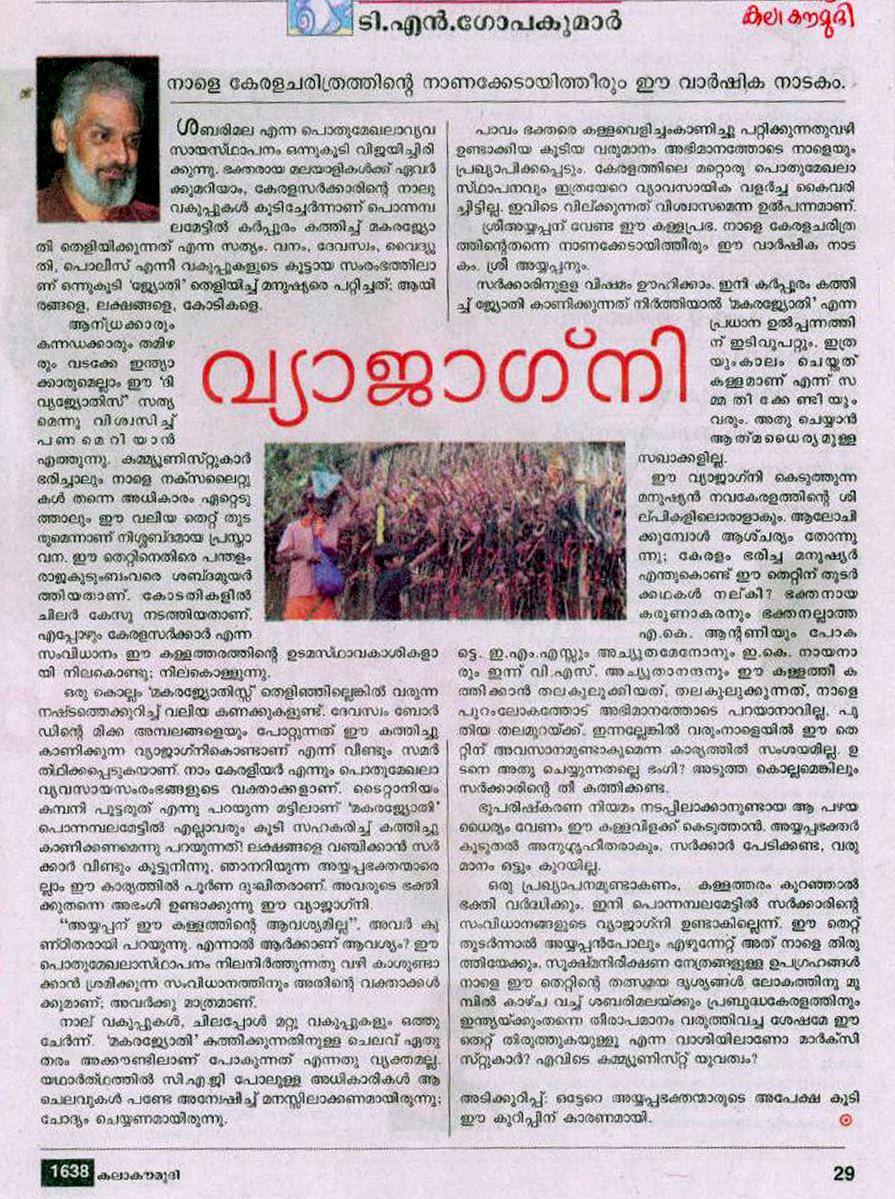
http://www.srai.org/tragedy-at-sabarimala-the-miracle-of-makara-jyothi/ <--- NDTV footage
http://wikimapia.org/#lat=9.4367003&lon=77.1073723&z=13&l=0&m=b <--- Wikimapia satellite map of Sabarimala and the terrain around, including the site of the recent tragedy
It is interesting to note that in one video the Devaswom Minister himself admits that the Makara Jyothi is lit by officials. The point I wish to stress is that such things gets swept under the carpet and the average devotee is tacitly encouraged to ascribe some kind of a divinity to the flickering light that appears on the hill side on the Sankranthi evening. The tempo is built up to fever pitch, and once something unpredictable or freaky happens and the crowds go ballistic, then it is a surefire formula for tragedy.
Again, who is to be blamed?
* * * * * * * * * * * *
YES, PRIME MINISTER
Dear Prime Ministerji,
Only an apology will set my mind at rest, Sir.
As one among the millions of "aam aadmis" you have chosen to represent and uplift, I all along had my faith in what pundits have come to call "Manmohanomics", and had dutifully, every year, listened/watched the budget broadcasts and trusted the learned opinions of the "expert panel" that it was all economic tightrope-walking and that it was not going to affect the "aam aadmi". Though the post-budget blues had hit me too I thought, I was by and large consoled by the studied opinions of the experts.
But recently my faith was shaken, nay hijacked, by the media, who claimed in their expose' that each of us "aam aadmis" had been "robbed" to the tune of a few thousand rupees, totalling a grand tidy sum, in what has now come to be labelled the 2G Scam. For an instant I lost my faith in your firm grasp of economics.
However, I when I heard Sibalji, I was relieved and heaved a great sigh. Frankly, I can count maybe to 25,000 or, at a pinch to 50,000, but arithmetic and figures have never been my strong points. (You should have been there when I went to the Treasury to collect my pension benefits and cursed myself for not attending to my maths classes, so I could tally up the bundle of notes handed to be by the teller!) Believe me, I had my own difficulties with the figures presented by your mInister Mr Sibal. But I believe in his figures fully and totally, as apparently you have, the moment you noticed that you must lay the facts and figures before your voters (sorry, no need to stand on technicalities; we ARE your voters, whether we voted for you or not), authorized him to do so. Adroit lawyer that he is, my feeling is that he is the greatest arithmatician since Aryabhata and Einstein. Kudos to his brilliant presentation, our minds have been cleared of any media-generated misconceptions. How cavalierly of us 'proletarians' to think that you never had our good in your heart. I thank Sibal for reminding us that the 2G procedure had insured the current low telecom rates enjoyed by us all.
On second thoughts, I guess I could view with admiration your perspicacity and economic sense when you silently advocated holding the price of spectrum at the 2001 levels. In our country when inflation is affecting everything else, it was indeed a laudatory step to try and rein in the price of something as important as radio spectrum, which I understand is critical to the development and progress of the country. You are fortunate to have at least two ministers in your cabinet who are conscious of the need to put a bridle on prices. One, of course, is Mr Raja. The other is Mr Deora, our petroleum minister, who takes a lot of flack unflinchingly. But everybody conveniently forgets the two or three times he cut the price of aviation fuel, which I think now is about Rs 45 plus a litre. Again, a gesture in the right direction, I think. The car is the rich man's toy; let us not forget that there are millions of "aam aadmis" flying to the Gulf and elsewhere in search of a job, who I am sure will be benefitted by the lower price of jet fuel.
I am hoping that with ministers like them and Mr Sibal, it wont be long before you could arrest the rocketing price of commodities and foodstuffs. Perhaps you should think of re-inducting Mr Raja into the Food ministry; it is the right thing to do as the humble man who just followed your economic line had to go out for no fault of his. Do consider seriously giving him the charge of the food ministry. Surely his firm-handed efforts should in no time send the prices, including those of onions, crashing to the 2001 levels.
Sir, our apologies to you for suspecting your wisdom as regards the "larger interests" of the nation. I am sure just as our minds have been calmed, you too must be experiencing a relief beyond compare now that you have set the record straight. Now at this peak of personal satisfaction that you have served the nation and its interests to the best of your ability, you must give up this thankless job and retire to the peace of some nearby sanctuary. But before you do that, will it be too much to ask you to put in place some legislation so that us poor "aaam aadmis" would be eligible for some refunds once the government implements the 2001 priceline for foodstuffs, kersosene, cooking gas, petrol and such stuff. I am sure your brilliant 'economic' mind could devise some way of doing that.
I cant hold my laughter when I think of all those moneyed fools who spent about five or six times the original price to buy off the spectrum from the original buyers. If they were keen, they need have only paid a marginal profit of a per cent or two. To have splurged so much of money, and that too on something as intangible as radio spectrum, shows that they were imprudent businessmen. Ah, it takes all sorts of people to make up this world; but then it should not affect us people whose consciences are clear.
On further thoughts, I have a feeling that your anti-inflationary price-holding tactics may not be for the good of the older generation at least. As things stand, "vanaprastham" does not cut much ice with the older generation--perhaps as it is not subsidized like pilgrimages,. But the prices of onions and everything else have had the salutary effect of making a large part of our population to once again discover and embrace the many attractions of a frugal living, which Gandhiji had all along advocated. As a recently retired person I could vouch for that. So maybe double-digit inflation is good, as it could be a virtual short-cut to "vanaprastha" and ultimate "moksha"!
Do sleep on that, Sir.
Once again, with apologies and salaams,
Sincerely yours,
Only an apology will set my mind at rest, Sir.
As one among the millions of "aam aadmis" you have chosen to represent and uplift, I all along had my faith in what pundits have come to call "Manmohanomics", and had dutifully, every year, listened/watched the budget broadcasts and trusted the learned opinions of the "expert panel" that it was all economic tightrope-walking and that it was not going to affect the "aam aadmi". Though the post-budget blues had hit me too I thought, I was by and large consoled by the studied opinions of the experts.
But recently my faith was shaken, nay hijacked, by the media, who claimed in their expose' that each of us "aam aadmis" had been "robbed" to the tune of a few thousand rupees, totalling a grand tidy sum, in what has now come to be labelled the 2G Scam. For an instant I lost my faith in your firm grasp of economics.
However, I when I heard Sibalji, I was relieved and heaved a great sigh. Frankly, I can count maybe to 25,000 or, at a pinch to 50,000, but arithmetic and figures have never been my strong points. (You should have been there when I went to the Treasury to collect my pension benefits and cursed myself for not attending to my maths classes, so I could tally up the bundle of notes handed to be by the teller!) Believe me, I had my own difficulties with the figures presented by your mInister Mr Sibal. But I believe in his figures fully and totally, as apparently you have, the moment you noticed that you must lay the facts and figures before your voters (sorry, no need to stand on technicalities; we ARE your voters, whether we voted for you or not), authorized him to do so. Adroit lawyer that he is, my feeling is that he is the greatest arithmatician since Aryabhata and Einstein. Kudos to his brilliant presentation, our minds have been cleared of any media-generated misconceptions. How cavalierly of us 'proletarians' to think that you never had our good in your heart. I thank Sibal for reminding us that the 2G procedure had insured the current low telecom rates enjoyed by us all.
On second thoughts, I guess I could view with admiration your perspicacity and economic sense when you silently advocated holding the price of spectrum at the 2001 levels. In our country when inflation is affecting everything else, it was indeed a laudatory step to try and rein in the price of something as important as radio spectrum, which I understand is critical to the development and progress of the country. You are fortunate to have at least two ministers in your cabinet who are conscious of the need to put a bridle on prices. One, of course, is Mr Raja. The other is Mr Deora, our petroleum minister, who takes a lot of flack unflinchingly. But everybody conveniently forgets the two or three times he cut the price of aviation fuel, which I think now is about Rs 45 plus a litre. Again, a gesture in the right direction, I think. The car is the rich man's toy; let us not forget that there are millions of "aam aadmis" flying to the Gulf and elsewhere in search of a job, who I am sure will be benefitted by the lower price of jet fuel.
I am hoping that with ministers like them and Mr Sibal, it wont be long before you could arrest the rocketing price of commodities and foodstuffs. Perhaps you should think of re-inducting Mr Raja into the Food ministry; it is the right thing to do as the humble man who just followed your economic line had to go out for no fault of his. Do consider seriously giving him the charge of the food ministry. Surely his firm-handed efforts should in no time send the prices, including those of onions, crashing to the 2001 levels.
Sir, our apologies to you for suspecting your wisdom as regards the "larger interests" of the nation. I am sure just as our minds have been calmed, you too must be experiencing a relief beyond compare now that you have set the record straight. Now at this peak of personal satisfaction that you have served the nation and its interests to the best of your ability, you must give up this thankless job and retire to the peace of some nearby sanctuary. But before you do that, will it be too much to ask you to put in place some legislation so that us poor "aaam aadmis" would be eligible for some refunds once the government implements the 2001 priceline for foodstuffs, kersosene, cooking gas, petrol and such stuff. I am sure your brilliant 'economic' mind could devise some way of doing that.
I cant hold my laughter when I think of all those moneyed fools who spent about five or six times the original price to buy off the spectrum from the original buyers. If they were keen, they need have only paid a marginal profit of a per cent or two. To have splurged so much of money, and that too on something as intangible as radio spectrum, shows that they were imprudent businessmen. Ah, it takes all sorts of people to make up this world; but then it should not affect us people whose consciences are clear.
On further thoughts, I have a feeling that your anti-inflationary price-holding tactics may not be for the good of the older generation at least. As things stand, "vanaprastham" does not cut much ice with the older generation--perhaps as it is not subsidized like pilgrimages,. But the prices of onions and everything else have had the salutary effect of making a large part of our population to once again discover and embrace the many attractions of a frugal living, which Gandhiji had all along advocated. As a recently retired person I could vouch for that. So maybe double-digit inflation is good, as it could be a virtual short-cut to "vanaprastha" and ultimate "moksha"!
Do sleep on that, Sir.
Once again, with apologies and salaams,
Sincerely yours,
Subscribe to:
Posts (Atom)